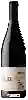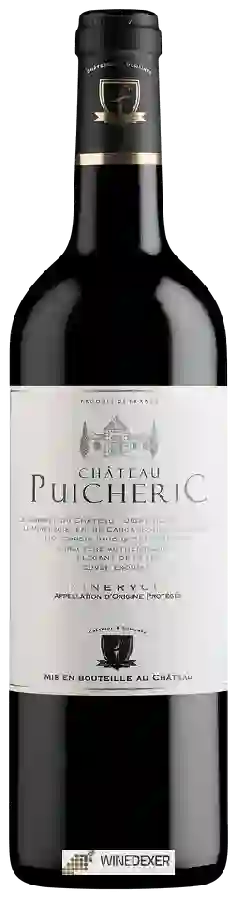
Château PuichéricMinervois
 Red wine



In the mouth this red wine is a powerful with a nice balance between acidity and tannins.
This wine generally goes well with beef, veal or pasta.
Taste structure of the Minervois from the Château Puichéric
Light | Bold | |
Smooth | Tannic | |
Dry | Sweet | |
Soft | Acidic |
In the mouth the Minervois of Château Puichéric in the region of Languedoc-Roussillon is a powerful with a nice balance between acidity and tannins.
Food and wine pairings with Minervois
Pairings that work perfectly with Minervois



Original food and wine pairings with Minervois
The Minervois of Château Puichéric matches generally quite well with dishes of beef, pasta or veal such as recipes of caramelized beef with onions, chinese soy and chicken noodles (wok style) or sot- l- leaves.
Details and technical informations about Château Puichéric's Minervois.
Discover the grape variety: Glera
It is said to be of Slovenian origin, where it is cultivated under the name of Prosekar, also known for a long time in Italy under the name of Glera. It should not be confused with prosecco lungo - although there is a family link - and prosecco nostrano, which is none other than Tuscany's malvasia. Note that Vitouska - another Italian grape variety - is the result of a natural intraspecific cross between Tuscan malvasia and Prosecco. Under the name of Glera, it is registered in the Official Catalogue of wine grape varieties list A. It can be found in practically all of the former Yugoslavia, and more surprisingly in Argentina, but is virtually unknown in France.
Last vintages of this wine
The best vintages of Minervois from Château Puichéric are 2016, 2015
Informations about the Château Puichéric
The Château Puichéric is one of of the world's greatest estates. It offers 5 wines for sale in the of Minervois to come and discover on site or to buy online.

The wine region of Minervois
Minervois is an appellation for distinctive red wines from the western Languedoc region of France. In general, they are softer than those produced in the Corbières, just to the South. The Minervois appellation also covers rosé and white wines. The predominant Grape varieties used in AOC Minervois wines are Grenache, Syrah and Mourvèdre.
The wine region of Languedoc-Roussillon
Languedoc (formerly Coteaux du Languedoc) is a key appellation used in the Languedoc-Roussillon wine region of southern France. It covers Dry table wines of all three colors (red, white and rosé) from the entire region, but leaves Sweet and Sparkling wines to other more specialized appellations. About 75% of all Languedoc wines are red, with the remaining 25% split roughly down the middle between whites and rosés. The appellation covers most of the Languedoc region and almost a third of all the vineyards in France.
The word of the wine: Castle
A term often used to designate wineries, even if they do not have a real castle.