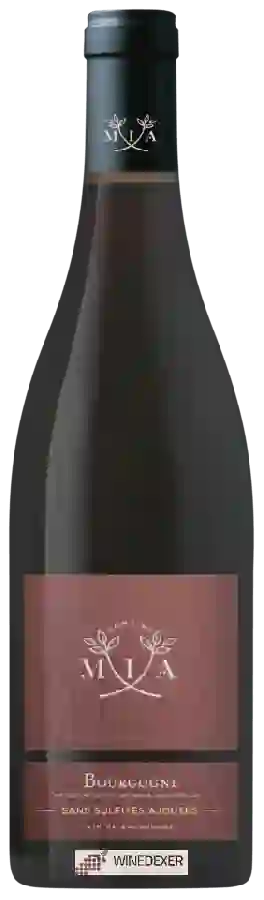
Domaine MIABourgogne
 wine
wine
In the mouth this wine is a with a nice freshness.
This wine generally goes well with
The Bourgogne of the Domaine MIA is in the top 0 of wines of Burgundy.
Taste structure of the Bourgogne from the Domaine MIA
Light | Bold | |
Smooth | Tannic | |
Dry | Sweet | |
Soft | Acidic |
In the mouth the Bourgogne of Domaine MIA in the region of Burgundy is a with a nice freshness.
Details and technical informations about Domaine MIA's Bourgogne.
Discover the grape variety: Herbemont
The origin of this American interspecific hybrid of the southern Vitis Aestivalis group, also called Vitis Bourquiniana, is not known for certain. In South Carolina (United States), it was propagated in the early 1800s by a Frenchman, Nicholas Herbemont (1771-1839), who found his first origins in Champagne. In France, it is one of six hybrids prohibited since 1935 (included in European regulations): Clinton, Herbemont, Isabelle, Jacquez, Noah and Othello. The Herbemont is very similar to the Jacquez - also called black spanish or lenoir - and has practically disappeared in favour of the latter.
Last vintages of this wine


The best vintages of Bourgogne from Domaine MIA are 0
Informations about the Domaine MIA
The Domaine MIA is one of of the world's greatest estates. It offers 10 wines for sale in the of Burgundy to come and discover on site or to buy online.

The wine region of Burgundy
Bourgogne is the catch-all regional appellation title of the Burgundy wine region in eastern France ("Bourgogne" is the French name for Burgundy). Burgundy has a Complex and comprehensive appellation system; counting Premier Cru and Grand Cru titles, the region has over 700 appellation titles for its wines. Thus, Burgundy wines often come from one Vineyard (or several separate vineyards) without an appellation title specific to the region, Village or even vineyard. A standard Burgundy wine may be made from grapes grown in one or more of Burgundy's 300 communes.
The word of the wine: Alcoholic fermentation
Transformation of sugars into alcohol under the effect of yeast. These yeasts exist in their natural state in the vineyards and in the cellars. Artificial seeding with selected yeasts is however very often practiced.